A Room with a View
Tom Kelliher, CS 320
Apr. 5, 2013
Read 5.1-3.
3-D projections, Movement in 3-D, Problems with 3-D movement.
- roomView.
- Model construction.
- Another way of thinking about coordinate systems and
transformations.
- Walk-through of roomView.c. Multiple viewports and
projections.
- Lab exercise.
Project day; light.
Consider building a room.
Two approaches:
- Pre-fab:
- A few object types.
- Each is built at the origin.
- Transformed into place.
- Stick-built:
- Exactly what is needed is built.
- Built in final location.
Again, two approaches:
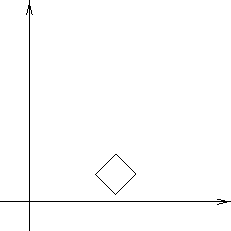
- Global, fixed coordinate system:
- All transformations relative to global coordinate system.
- Transformation order, code order reversed.
Rotate, then translate:
mv = Translate(...) * RotateX(...);
...
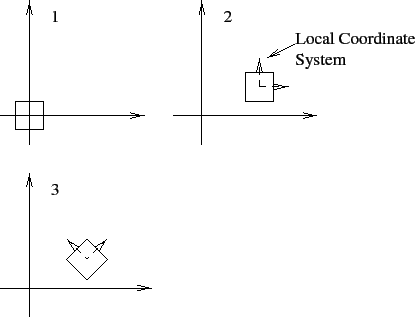
- Local, movable coordinate system:
- Imagine a local coordinate system fixed to the object.
- Initially, local system is identical to global system.
- Transformations are applied to the local system.
- Transformation order, code order the same:
Translate, then rotate:
mv = Translate(...) * RotateX(...);
...
What's the difference???
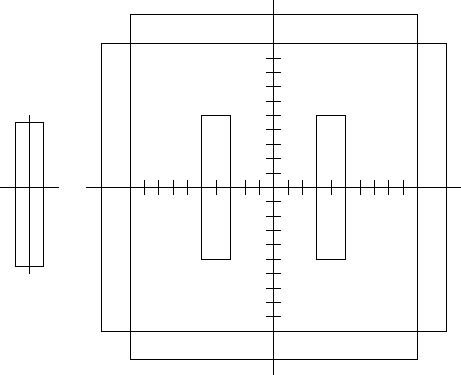
Consider the transformations necessary for constructing:
when what you have to start with is the one block.
Steps:
reset to world frame;
translate 4 left
draw;
translate 8 right;
draw;
reset to world frame;
translate 11 left, 5 down;

// Repeat the following 4 times.
draw;
translate 10 up;
draw;
translate 6 right and 6 up;
rotate -90;              // Why -90???
draw;
move 10 up;
draw;                    // Don't forget that we also rotated the
                         // local coordinate system!
See room() for the real code.
A couple vertex lists:
Point Wall[] =
{ Point(-1.0, -5.0, 0.0), Point( 1.0, -5.0, 0.0),
  Point( 1.0,  5.0, 0.0), Point(-1.0,  5.0, 0.0),
  Point(-1.0, -5.0, 8.0), Point( 1.0, -5.0, 8.0),
  Point( 1.0,  5.0, 8.0), Point(-1.0,  5.0, 8.0)
};

Point Floor[] =
{ Point(-12.0, -12.0, 0.0), Point( 12.0, -12.0, 0.0),
  Point( 12.0,  12.0, 0.0), Point(-12.0,  12.0, 0.0)
};
Is there a general way for drawing?
colorCube():
- ``Canonical'' cube vertex list.
- Drawing various cubes (vertex lists).
- Color vectors.
// colorCube draws a cube.
//    vertices: the vertex list specifying the cube.
//
// Assumptions regarding the vertex list:
// Index   Vertex
//   0     Lower left vertex of bottom face.
//   1     Lower right vertex of bottom face.
//   2     Upper right vertex of bottom face.
//   3     Upper left vertex of bottom face.
// 4--7    Similar for top face.
// (Assumes we are looking at the origin from the +z axis with the +y axis
//  being "up."
//
// generate 12 triangles: 36 vertices.

void colorcube(const Point vertices[])
{
    quad( vertices, 1, 0, 3, 2 );
    quad( vertices, 2, 3, 7, 6 );
    quad( vertices, 3, 0, 4, 7 );
    quad( vertices, 6, 5, 1, 2 );
    quad( vertices, 4, 5, 6, 7 );
    quad( vertices, 5, 4, 0, 1 );
}
quad():
- Drawing various quads.
// quad generates two triangles for each face.

void quad(const Point vertices[], int a, int b, int c, int d )
{
    points[Index] = vertices[a]; Index++;
    points[Index] = vertices[b]; Index++;
    points[Index] = vertices[c]; Index++;
    points[Index] = vertices[a]; Index++;
    points[Index] = vertices[c]; Index++;
    points[Index] = vertices[d]; Index++;
}
- Detail from
init() showing creation of drawn objects:
   Index = 0;
   colorcube(Wall);                // Dumps vertices into points.
   oWall.vao = createVAO();        // Uses vertices from points.
   oWall.numVertices = 36;
   oWall.geometry = GL_TRIANGLES;

   Index = 0;
   quad(Floor, 0, 1, 2, 3);
   oFloor.vao = createVAO();
   oFloor.numVertices = 6;
   oFloor.geometry = GL_TRIANGLES;

   Index = 0;
   quad(Viewer, 0, 1, 2, 3);
   oViewer.vao = createVAO();
   oViewer.numVertices = 6;
   oViewer.geometry = GL_TRIANGLES;
- Ordinarily, the projection mode is set-up in reshape().
What about this case?
Sketch of display():
clear color and depth buffers;

// Prepare for the map view.
set an orthographic projection;
set viewport;

draw room;
draw viewer;

flush all polygons;   // Ensure that none are "hanging" around.

// Prepare for the first-person view
set a perspective projection;
set viewport;

position the camera;   // Remember: viewer transformation, then
                       // model transformations.

draw room;
draw ceiling;

swap color buffers;
- Implementation of
display():
void display(void)
{
   mat4 p;    /* Projection matrix */

   glClear(GL_COLOR_BUFFER_BIT | GL_DEPTH_BUFFER_BIT);

   // Set-up to draw the map.

   p = Ortho(-13.0, 13.0, -13.0, 13.0, -10.0, 1.0);
   glUniformMatrix4fv(projection, 1, GL_TRUE, p);

   glViewport(0, 0, 100, 100);

   // Draw viewer.

   mv = Translate(viewerPosition[0], viewerPosition[1], 10.0);
   glUniformMatrix4fv(model_view, 1, GL_TRUE, mv);
   glBindVertexArray(oViewer.vao);
   glUniform3fv(vColor, 1, black);
   glDrawArrays(oViewer.geometry, 0, oViewer.numVertices);

   // Draw the room.

   mv = Translate(0.0, 0.0, 0.0);
   glUniformMatrix4fv(model_view, 1, GL_TRUE, mv);
   room();

   glFlush();

   // Set-up the do the first-person view.

   p = Perspective(90.0, 1.0, 0.1, 100.0);
   glUniformMatrix4fv(projection, 1, GL_TRUE, p);

   glViewport(100, 100, windowWidth - 100, windowHeight - 100);

   // Position the camera.
   mv = LookAt(vec4(viewerPosition[0], viewerPosition[1],
                    viewerPosition[2], 1.0),
               vec4(viewerPosition[0] + cos(viewerTheta),
                    viewerPosition[1] + sin(viewerTheta),
                    viewerPosition[2], 1.0),
               vec4(0.0, 0.0, 1.0, 1.0));
   glUniformMatrix4fv(model_view, 1, GL_TRUE, mv);

    room();

   // Draw ceiling.
   mv = mv * Translate(0.0, 0.0, 8.0);
   glUniformMatrix4fv(model_view, 1, GL_TRUE, mv);
   glBindVertexArray(oFloor.vao);
   glUniform3fv(vColor, 1, magenta);
   glDrawArrays(oFloor.geometry, 0, oFloor.numVertices);

   glutSwapBuffers();
}
room():
/*********************************************************************
 * room() --- draw the room.  Because of the separate needs of the map
 * and first-person views, it draws neither the ceiling nor the
 * viewer.
 *********************************************************************/

void room()
{
   mat4 lmv;   // Local copy of the global modelview matrix.

   // Draw floor.
   glBindVertexArray(oFloor.vao);
   glUniform3fv(vColor, 1, white);
   glDrawArrays(oFloor.geometry, 0, oFloor.numVertices);

   // Draw middle walls.
   lmv = mv * Translate(-4.0, 0.0, 0.0);
   glUniformMatrix4fv(model_view, 1, GL_TRUE, lmv);
   glBindVertexArray(oWall.vao);
   glUniform3fv(vColor, 1, red);
   glDrawArrays(oWall.geometry, 0, oWall.numVertices);
   lmv = lmv * Translate(8.0, 0.0, 0.0);
   glUniformMatrix4fv(model_view, 1, GL_TRUE, lmv);
   glDrawArrays(oWall.geometry, 0, oWall.numVertices);

   // Draw walls defining room boundaries.

   lmv = mv * Translate(-11.0, -5.0, 0.0);
   glUniformMatrix4fv(model_view, 1, GL_TRUE, lmv);

   for (int i = 0; i < 4; i++)
   {
      glUniform3fv(vColor, 1, (i == 1) ? green : blue);
      glDrawArrays(oWall.geometry, 0, oWall.numVertices);
      lmv = lmv * Translate(0.0, 10.0, 0.0);
      glUniformMatrix4fv(model_view, 1, GL_TRUE, lmv);
      glUniform3fv(vColor, 1, (i == 1) ? green : blue);
      glDrawArrays(oWall.geometry, 0, oWall.numVertices);
      lmv = lmv * Translate(6.0, 6.0, 0.0) * RotateZ(-90.0);
      glUniformMatrix4fv(model_view, 1, GL_TRUE, lmv);
   }
}
- From class Web site, grab roomviewLab.zip.
- Build and run. Note:
- Use arrow keys to increment/decrement x/y to move.
- Add viewer rotation and fix left, right, forward, backward motion.
Use
A and S keys for rotation.
- Can you modify the program so that the first-person view is
full-window, with the map view movable to any corner of the window?
- Can you add collision detection?
Thomas P. Kelliher
2013-04-04
Tom Kelliher