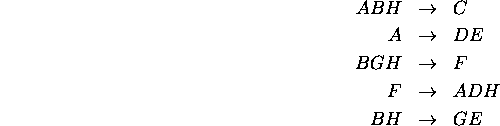
Minimal covers come close.
 be a set of FDs. The set of FDs
  is a minimal
cover of
is a minimal
cover of  if:
if:
-
 is equivalent to
  .
.
- All FDs in
 have the form
  where A is a singleton attribute.
- It is not possible to make
 smaller by either:
- Deleting an FD from
 .
.
- Deleting an attribute from the LHS of one of
 's FDs.
- Deleting an FD from
 :
:
- Compute
 :=
:=  where the FDs in
  have
singleton RHSs.
have
singleton RHSs.
Note: Just apply FD decomposition.
- Remove redundant attributes from the RHSs of FDs of
 .
.
Note on computation: To check to see if
 in
in
 of
of  is redundant, check
whether or not
is redundant, check
whether or not 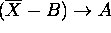 is entailed by
  .
.
- Remove redundant FDs from
 .
.
Note on computation: To check to see if an FD of
 is redundant,
create
is redundant,
create  which is just
  without the candidate
redundant FD. Check whether or not the candidate FD is entailed by
without the candidate
redundant FD. Check whether or not the candidate FD is entailed by
 .
.
 is a minimal cover of
  .
.
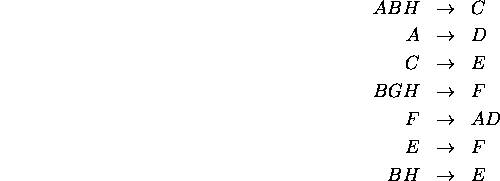

 , of
, of  .
.
 into sets
  where the FDs in a
 all have the same LHS. Minimize
  .
.
 , the corresponding relation schema is
 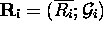 where
where  contains all
the attributes mentioned in
contains all
the attributes mentioned in  .
.
 is a superkey of R, we are done.
(Check
is a superkey of R, we are done.
(Check  .)
.)
 be a key of
  . Add
. Add 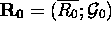 to the schema set.
 :
:
 and
and  contains

 .
.

 in
Decomposition that is not in BCNF do
in
Decomposition that is not in BCNF do  in
in  violates BCNF. */
  in Decomposition with schemas
 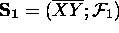 and
and  where
where  and
and  are all the FDs of
  that involve only
  no longer violate BCNF?
 where
where  and
and  contains: