Other Operand Types, Program Build Process

Tom Kelliher, CS 240

Feb. 20, 2004

Administrivia

Announcements

Assignment

Read 4.1--4.5 (stop when you reach ``Carry Lookahead'' on pg. 241).

From Last Time

Finished up function call mechanism.

Outline

  1. Character strings.

  2. Summary of operand addressing.

  3. Program build process.

Coming Up

Building a MIPS ALU.

Character Strings

  1. C strings are char arrays terminated by a NULL character.

  2. In MIPS assembler, .asciiz is a NULL-terminated string.

    .ascii is not terminated.

    Example functions we'll look at:

    1. int strlen(char *s)

    2. char * strcat(char *dest, char *src)

      strcat is dangerous --- buffer overflows.

  3. strlen:
    1. C code:
      int strlen(char *s)
      {
         char *t = s;
      
         while (*t != '\0')
            ++t;
      
         return t - s;
      }
      

    2. Basic MIPS code:
      # s in $a0
      # t in $t0
      # Current character of s in $t1
      # strlen returned via $v0
      
                     move $t0, $a0
      while:         lbu $t1, 0($t0)
                     beqz $t1, endWhile
                     addi $t0, $t0, 1
                     b while
      endWhile:      sub $v0, $t0, $a0
      

  4. strcat:
    1. C code:
      char * strcat(char *dest, char *src)
      {
         char *t = dest;
      
         while (*t != '\0')     /* Find end of dest. */
            ++t;
      
         while (*src != '\0')   /* Start appending src to dest. */
         {
            *t = *src;
            ++t;
            ++src;
         }
      
         *t = '\0';             /* Append NULL to dest. */
         return dest;
      }
      

    2. Basic MIPS code:
      # dest in $a0
      # src in $a1
      # t in $t0
      # current character in $t1
      # dest returned via $v0
      
                     move $t0, $a0
      while1:        lbu $t1, 0($t0)
                     beqz $t1, endWhile1
                     addi $t0, $t0, 1
                     b while
      endWhile1:
      while2:        lbu $t1, 0($a1)
                     beqz $t1, endWhile2
                     sb $t1, 0($t0)
                     addi $t0, $t0, 1
                     addi $a1, $a1, 1
                     b while2
      endWhile2:     sb $0, 0($t0)
                     move $v0, $a0
      

Summary of Operand Addressing Styles

Register, immediate, base and offset, PC-relative, ``direct.''

Base and offset is a form of indirect addressing.

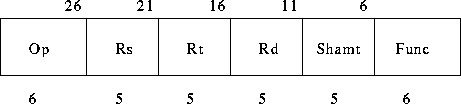
  1. Register mode. Format:

    Example: add $t0, $t0, $t1
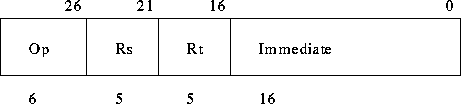
  2. Immediate mode. Format:

    Examples:

    addi $t0, $t0, 1
    lw $t1, 4($t0)
    

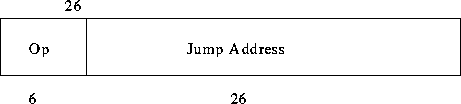
  3. Suppose we need to branch further than words?
    1. Example: procedure call in huge program.

    2. Solution: J format:

      Example: j reallyFarLabel

    3. Conditional branch example:
                     <code>
      while:         beq $t0, $t1, reallyFarLabel
                     <lots of code>
                     b while
      
      becomes:
                     <code>
      while:         bne $t0, $t1, near
                     j reallyFarLabel
      near:          <lots of code>
                     j while
      

    4. Why can't this take us anywhere in memory?

      Solved with jr!

Program Build Process

These are just comments. Make sure you read 3.9 on your own!

  1. Assembler output: object file ---
    1. Data segment holds constants, generally strings and arrays. Scalar constants will be embedded in the code.

      Dynamic data is maintained in the heap segment.

    2. Relocation absolute addresses: J format and jr style instructions.

      Program assembled assuming it will be load starting at address 0. This is never the case.

    3. Symbol table's external references --- must be resolved by the linker.

  2. Linker output: executable file ---
    1. External references are resolved --- library code must be added to the code segment and absolute addresses for library function calls must be filled in within the original program.

      Example: printf("The answer is: %d", ans);

    2. Static linking.

  3. Loader: load executable into memory and set execution environment.

    Dynamic linking.


Thomas P. Kelliher
Wed Feb 18 17:03:53 EST 2004
Tom Kelliher