Other Operand Types, Program Build Process
Tom Kelliher, CS 240
Feb. 18, 2002
If you didn't see my e-mail:
- HW II is due Monday, March 4.
- The first exam will be Friday, March 8.
Read 3.10. I will have you compile a C function to MIPS assembler in
class. You will:
- Decide what registers you will use.
- Produce a frame map.
- Compile the function into MIPS.
- Write and add code to push/pop the frame, save/restore registers,
etc.
Finished up function call mechanism.
- Character strings.
- Summary of operand addressing.
- Program build process.
Function writing lab.
- C strings are char arrays terminated by a NULL character.
- In MIPS assembler,
.asciiz is a NULL-terminated string.
.ascii is not terminated.
Example functions we'll look at:
-
int strlen(char *s)
-
char * strcat(char *dest, char *src)
strcat is dangerous --- buffer overflows.
-
strlen:
- C code:
int strlen(char *s)
{
   char *t = s;

   while (*t != '\0')
      ++t;

   return t - s;
}
- Basic MIPS code:
# s in $a0
# t in $t0
# Current character of s in $t1
# strlen returned via $v0

               move $t0, $a0
while:         lbu $t1, 0($t0)
               beqz $t1, endWhile
               addi $t0, $t0, 1
               b while
endWhile:      sub $v0, $t0, $a0
-
strcat:
- C code:
char * strcat(char *dest, char *src)
{
   char *t = dest;

   while (*t != '\0')     /* Find end of dest. */
      ++t;

   while (*src != '\0')   /* Start appending src to dest. */
   {
      *t = *src;
      ++t;
      ++src;
   }

   *t = '\0';             /* Append NULL to dest. */
   return dest;
}
- Basic MIPS code:
# dest in $a0
# src in $a1
# t in $t0
# current character in $t1
# dest returned via $v0

               move $t0, $a0
while1:        lbu $t1, 0($t0)
               beqz $t1, endWhile1
               addi $t0, $t0, 1
               b while
endWhile1:
while2:        lbu $t1, 0($a1)
               beqz $t1, endWhile2
               sb $t1, 0($t0)
               addi $t0, $t0, 1
               addi $a1, $a1, 1
               b while2
endWhile2:     sb $0, 0($t0)
               move $v0, $a0
Register, immediate, base and offset, PC-relative, ``direct.''
Base and offset is a form of indirect addressing.
- Register mode. Format:
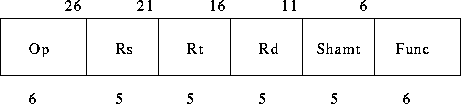
Example: add $t0, $t0, $t1
- Immediate mode. Format:
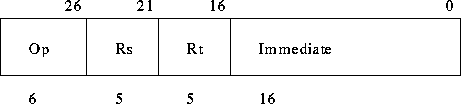
Examples:
addi $t0, $t0, 1
lw $t1, 4($t0)
- Suppose we need to branch further than
 words?
- Example: procedure call in huge program.
- Solution: J format:
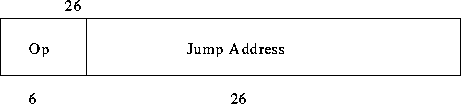
Example: j reallyFarLabel
- Conditional branch example:
               <code>
while:         beq $t0, $t1, reallyFarLabel
               <lots of code>
               b while
becomes:
               <code>
while:         bne $t0, $t1, near
               j reallyFarLabel
near:          <lots of code>
               j while
- Why can't this take us anywhere in memory?
Solved with jr!
These are just comments. Make sure you read 3.9 on your own!
- Assembler output: object file ---
- Data segment holds constants, generally strings and arrays.
Scalar constants will be embedded in the code.
Dynamic data is maintained in the heap segment.
- Relocation absolute addresses: J format and
jr style
instructions.
Program assembled assuming it will be load starting at address 0. This
is never the case.
- Symbol table's external references --- must be resolved by the
linker.
- Linker output: executable file ---
- External references are resolved --- library code must be
added to the code segment and absolute addresses for library function
calls must be filled in within the original program.
Example: printf("The answer is: %d", ans);
- Static linking.
- Loader: load executable into memory and set execution environment.
Dynamic linking.
Thomas P. Kelliher
Fri Feb 15 14:06:03 EST 2002
Tom Kelliher