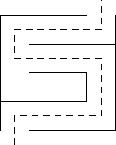
.
.
Orthogonal projection; viewing volume.
 window. The maze won't always be square.
Also, deal with resizing. See
window. The maze won't always be square.
Also, deal with resizing. See reshape() in quadric.c.
Fall backs:
- Square maze.
- Square window (window not resized).
Tom Kelliher, CS 320
Feb. 9, 2005
Re-read Chapter 2.
OpenGL API.
2-D graphics and OpenGL lab.
.
Orthogonal projection; viewing volume.
window. The maze won't always be square.
Also, deal with resizing. See reshape() in quadric.c.
Fall backs:
 .
Generalization: any size array, dynamically sized at run-time. Extra
credit.
.
Generalization: any size array, dynamically sized at run-time. Extra
credit.
Entrance lower-left bottom, exit upper-right top.
Redundancy: remove.
Draw south, west maze walls.
struct declaration:
typedef struct cell
{
   int visited;
   int north;
   int east;
} cell;
cell maze[ROWS][COLS];

main(...)
{
   process args;

   set-up window;
   set-up world;

   initialize maze and seed random number generator;

   /* Create a random maze. */
   visit(start cell);

   /* Exit on mouse click. */
   register MouseFunc;

   /* On re-display clear window, redraw maze, re-compute
    *   and display path.
    */
   register DisplayFunc;

   /* IdleFunc unused!!! */

   /* "Prime the pump." */
   post a redisplay event;

   enter MainLoop;
}
visit(current cell)
{
   mark current cell visited;

   Randomly arrange the four compass directions

   for each of the four randomly arranged compass directions
      if new cell exists and is unvisited
      {
         remove appropriate wall;
         visit(new cell);
      }
}
Idea: Get a sequence of cells from start cell to end cell on the call stack and draw path from end to start.
Don't forget to mark all maze cells as unvisited before first call!
Initial call: path(start cell, end cell);
path(current cell, target cell)
{
   mark current cell visited;

   if current cell == target cell
      return 1;

   for each of the four neighbor cells
      if new cell exists and is unvisited
         if (path(new cell, target cell))
         {
            draw segment from current cell to new cell;
            return 1;
         }

   return 0;
}
Need to draw entry/exit segments. Use two colors.  maze:
maze: