Direct Proof & Counterexample: Introduction
Tom Kelliher, MA 115
Oct. 8, 1997
- Read 3.2.
- Homework problems from 3.1, due 10/15: 7, 16, 24, 28, 34, and 43.
Proofs:
- Difficulties:
- Remembering definitions.
- Finding your way in the ``maze.''
- Taking small steps --- filling in the details.
- Importance:
- Sharpening analytical and creative skills.
- Confidence in applying an idea to all possible cases. (``Proof by
example.'')
Foundation from which we begin:
- Basic algebra --- Appendix A.
- Closure of integers under addition, subtraction, and multiplication.
What about division???
For n an integer.
Even:

Odd:

Examples:
- Is 6m + 8n even or odd?
- Is 10mn + 7 even or odd?
For n an integer that is greater than 1.
Prime:

Composite:

Examples:
- if r and s are both positive integers, is
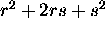 composite?
- if m > n > 0, is
 composite?
(Existential proofs aren't unimportant.)
- Method of generalizing from the generic particular.
- Method of direct proof:
- Mentally, express the statement to be proved in the form

- Start by assuming that x is a particular, but arbitrarily
chosen, member of D for which
 is true.
- Show that
 is true (the hard part).
- Proof writing guidelines:
- Write the theorem to be proved.
- Clearly mark the beginning of the proof: Proof.
- Make the proof self-contained.
- Take small steps; justify each step.
- Write in English.
- Finish with Q.E.D.
- Prove that the difference of two even integers is even.
- Prove that the difference of an even and an odd integer is odd.
- Prove that the product of any four consecutive integers is one less
than a perfect square.
These are for laughs only. If I see you using these...
- Proof by example:
The author gives only the case n = 2 and suggests that it contains most
of the ideas of the general proof.
- Proof by intimidation:
``Trivial'' or ``obvious.''
- Proof by exhaustion:
An issue or two of a journal devoted to your proof is useful.
- Proof by omission:
``The reader may easily supply the details'', ``The other 253 cases are
analogous''
- Proof by obfuscation:
A long plotless sequence of true and/or meaningless syntactically
related statements.
- Proof by wishful citation:
The author cites the negation, converse, or generalization of a theorem
from the literature to support his claims.
- Proof by funding:
How could three different government agencies be wrong? Or, to play the
game a different way: how could anything funded by those bozos be
correct?
- Proof by democracy:
A lot of people believe it's true: how could they all be wrong?
- Proof by market economics:
Mine is the only theory on the market that will handle the data.
- Proof by eminent authority:
``I saw Ruzena in the elevator and she said that was tried in the 70's
and doesn't work."
- Proof by cosmology:
The negation of the proposition is unimaginable or meaningless. Popular
for proofs of the existence of God and for proofs that computers cannot
think.
- Proof by personal communication:
``Eight-dimensional colored cycle stripping is NP-complete [Karp,
personal communication].''
- Proof by reference to talk:
``At the special NSA workshop on computer vision, Binford proved that
SHGC's could be recognized in polynomial time.''
- Proof by reduction to the wrong problem:
``To see that infinite-dimensional colored cycle stripping is
decidable, we reduce it to the halting problem.''
- Proof by reference to inaccessible literature:
The author cites a simple corollary of a theorem to be found in a
privately circulated memoir of the Icelandic Philological Society,
1883. This works even better if the paper has never been translated
from the original Icelandic.
- Proof by ghost reference:
Nothing even remotely resembling the cited theorem appears in the
reference given. Works well in combination with proof by reference to
inaccessible literature.
- Proof by forward reference
Reference is usually to a forthcoming paper of the author, which is
often not as forthcoming as at first.
- Proof by importance:
A large body of useful consequences all follow from the proposition in
question.
- Proof by accumulated evidence:
Long and diligent search has not revealed a counterexample.
- Proof by mutual reference:
In reference A, Theorem 5 is said to follow from Theorem 3 in reference
B, which is shown to follow from Corollary 6.2 in reference C, which is
an easy consequence of Theorem 5 in reference A.
- Proof by metaproof:
A method is given to construct the desired proof. The correctness of
the method is proved by any of these techniques. A strong background in
programming language semantics will help here.
- Proof by picture:
A more convincing form of proof by example. Combines well with proof by
omission.
- Proof by flashy graphics:
A moving sequence of shaded, 3D color models will convince anyone that
your object recognition algorithm works. An SGI workstation is helpful
here.
- Proof by misleading or uninterpretable graphs:
Almost any curve can be made to look like the desired result by
suitable transformation of the variables and manipulation of the axis
scales. Common in experimental work.
- Proof by vehement assertion:
It is useful to have some kind of authority relation to the audience,
so this is particularly useful in classroom settings.
- Proof by repetition:
Otherwise known as the Bellman's proof: ``What I say three times is
true.''
- Proof by appeal to intuition:
Cloud-shaped drawings frequently help here.
- Proof by vigorous handwaving:
Works well in a classroom, seminar, or workshop setting.
- Proof by semantic shift:
Some of the standard but inconvenient definitions are changed for the
statement of the result.
- Proof by cumbersome notation:
Best done with access to at least four alphabets, special symbols, and
the newest release of LaTeX.
- Proof by abstract nonsense:
A version of proof by intimidation. The author uses terms or theorems
from advanced mathematics which look impressive but are only
tangentially related to the problem at hand. A few integrals here, a
few exact sequences there, and who will know if you really had a proof?
- Disproof by finding a bad apple:
One bad apple spoils the whole bunch. Among the many proponents of this
theory, we have found one who is obviously loony; so we can discredit
the entire theory. (Often used in political contexts.)
- Disproof by slippery slope (or thin end of wedge, if you are British):
If we accepted [original proposal], we'd have to accept [slightly
modified proposal], and eventually this would lead to [radically
different and clearly objectionable proposal].
- Disproof by ``not invented here'':
We have years of experience with this equipment at MIT and we have
never observed that effect.
Thomas P. Kelliher
Tue Oct 7 15:41:18 EDT 1997
Tom Kelliher